 Pretzly
German Plural Forms Explained: The 5 Patterns
English adds -s. German has five patterns, umlauts, and opinions. But there's more system here than most textbooks admit.
The five plural patterns
| Pattern | Example | Most common with |
|---|---|---|
| -e (often + umlaut) | der Tisch → die Tische; die Hand → die Hände | Masculine & feminine one-syllable nouns |
| -(e)n | die Wohnung → die Wohnungen; die Lampe → die Lampen | Feminine nouns — by far the biggest group |
| -er (often + umlaut) | das Haus → die Häuser; das Kind → die Kinder | Neuter one-syllable nouns |
| -s | das Auto → die Autos; das Handy → die Handys | Loanwords, words ending in a vowel other than -e |
| no ending (sometimes umlaut) | der Lehrer → die Lehrer; der Vater → die Väter | Masculine/neuter nouns ending in -er, -el, -en |
The shortcuts that predict the pattern
- Feminine noun? ~90% take -(e)n: die Zeitung → die Zeitungen, die Erfahrung → die Erfahrungen. If you know it's die, guess -en and you'll usually be right.
- Ends in -e? Add -n: die Sprache → die Sprachen.
- Masculine/neuter ending in -er, -el, -en? Usually unchanged: der Fehler → die Fehler.
- Diminutives -chen / -lein? Never change: das Mädchen → die Mädchen.
- Foreign/loanword ending in -a, -i, -o, -u or -y? Take -s: das Sofa → die Sofas, das Auto → die Autos. This is why Häuser but Autos — Auto is a loanword.
- Neuter one-syllable noun? Suspect -er with umlaut: das Buch → die Bücher.
Notice the through-line: the article you learned with the noun predicts the plural. One more reason never to learn a bare noun — gender, plural and meaning form one package. (If articles are still shaky, start with how to remember der, die, das.)
What about "-" plurals in dictionaries?
Some German nouns have no plural at all — uncountables like das Obst (fruit) or die Milch. Dictionaries mark these with a dash. Don't invent a plural for them; the dash is legitimate information, not a gap.
How to actually learn plurals (without memorizing tables)
- Learn each noun as a triple: article + singular + plural. "die Wohnung, die Wohnungen" — said aloud, as one breath.
- Trust the shortcuts first. Guess by gender and ending; you'll be right most of the time, and the misses are exactly the words worth extra reviews.
- Let frequency do the sorting. The irregular plurals that matter (Häuser, Männer, Bücher) are all high-frequency words — you'll meet them constantly. Rare irregulars can wait.
Plurals on every card, filled in by AI
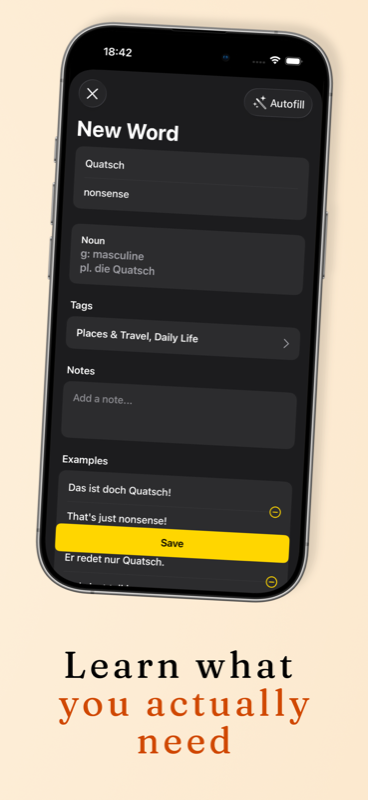
In Pretzly every noun card carries its article and plural — the curated 2800-word library has them built in, and when you add your own word, AI Autofill completes the gender, plural form and example sentences automatically. You learn the triple without ever typing it.
 Get the app — free
Quick self-test
Cover the right column and predict: die Möglichkeit → ? (die Möglichkeiten). das Zimmer → ? (die Zimmer). der Stuhl → ? (die Stühle). das Hotel → ? (die Hotels). If you got three of four, the shortcuts are already working.