 Pretzly
German vocabulary · iPhone & iPad
Learn German vocabulary that actually sticks
2800+ curated German words from A1 to C2 — every one with its article, plural, pronunciation and real example sentences. Train der, die, das until it's instinct, build your own dictionary, and keep your streak alive in minutes a day.
4.8 on the App Store 2800+ words, A1–C2 7-day free Premium trial
Try it right here
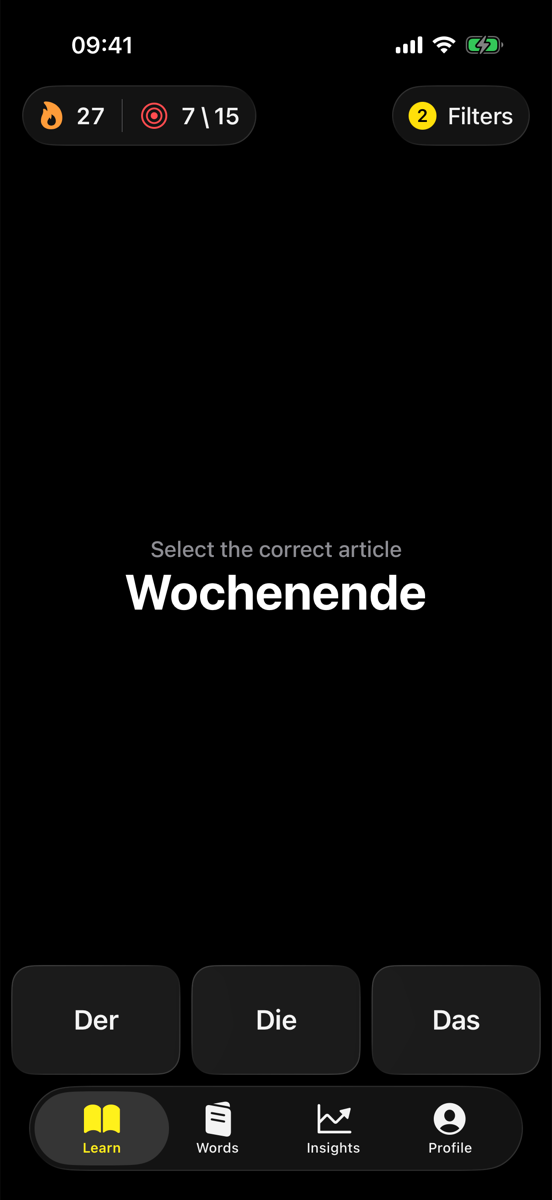
Der, die or das?
This is the actual exercise from the app. Ending patterns predict most German genders — feel how fast it becomes instinct.
Select the correct article
Wochenende
Tap an answer — streak: 0
How it works
Three steps to a German vocabulary habit
Built around spaced, active recall — the only technique that reliably moves words into long-term memory.
Pick your level & topics
Choose your level from A1 to C2 and the topics you actually need — Daily Life, Work, Travel and more. The app serves you the right 2800+ curated words, or add your own and let AI fill in gender, plural and examples.
Practice a few minutes a day
Quick exercises test translations and der-die-das articles. Every word comes with context sentences, so you learn how Germans actually use it — not just what it means.
Stay consistent, watch it stick
A daily goal, streaks and Insights keep you honest. Focus Mode can even block your social apps until today's practice is done — scroll time becomes study time.
Why Pretzly
Everything a German vocabulary trainer should do
No decks to configure, no course to follow in order. Open the app, practice today's words, get on with your day.
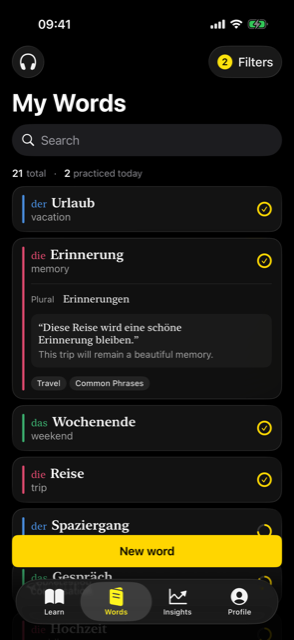
Your own dictionary, built by AI
Add any word you meet in real life — Autofill completes the article, plural, translations and native-sounding example sentences in seconds. 2800+ curated words from A1 to C2 are already inside.
Streaks & daily goals
Progress you can see keeps you coming back.
“I’ve been waiting for an app like this for so long! Learning German vocabulary finally works.”— App Store review, Germany
Listen Mode
Your dictionary as a podcast — words and sentences read aloud, hands-free on the commute.
Focus Mode
Your social apps stay locked until today’s words are done. Scroll time becomes study time.
Grammar on every card
Plural forms, verb tenses, adjective comparisons — vocabulary and grammar in one place, drilled with spaced active recall.
Guides
Learn German smarter
Practical, no-fluff answers to the questions every German learner asks — and how to put them into practice.
German Grammar
How to Remember Der, Die, Das
The ending patterns that decide most noun genders, memory tricks that work, and how to drill articles until they're automatic.
Read the guide → PluralsGerman Plural Forms Explained
Why it's Häuser but Autos: the five plural patterns, which endings predict them, and how to learn plurals without pain.
Read the guide → VerbsGerman Perfekt Tense Explained
The past tense Germans actually speak: haben vs sein, how to build the participle, and the irregulars worth learning first.
Read the guide → AdjectivesGerman Comparative & Superlative Forms
Schnell, schneller, am schnellsten — the one pattern, when umlauts appear, the irregulars, and als vs wie.
Read the guide →Vocabulary & Levels
German A1 Vocabulary: The Words to Learn First
The ~500 words that unlock everyday German, organized by topic — and the right way to learn them so they stick.
Read the guide → FluencyHow Many German Words Do You Need to Be Fluent?
Real vocabulary sizes for A1 through C2, what "fluent" actually requires, and how to get there fastest.
Read the guide →Speaking & Listening
How to Improve Your German Pronunciation
The sounds English speakers get wrong, how to fix them with listen-and-repeat practice, and building an ear for German.
Read the guide → ListeningLearn German by Listening
Turn commutes and chores into study time: active vs passive listening, shadowing, and level-appropriate audio.
Read the guide →Method & Motivation
How to Learn German Vocabulary Fast
Spaced repetition, active recall, context sentences — the techniques with evidence behind them, and the ones to skip.
Read the guide → ComparisonBest App to Learn German Vocabulary in 2026
What separates a real vocabulary trainer from a streak toy — and how to choose the right app for your level and goals.
Read the guide → ConsistencyLearn German in 10 Minutes a Day
Why tiny daily sessions beat weekend marathons, and how streaks, daily goals and Focus Mode make consistency automatic.
Read the guide →FAQ
Frequently asked questions
How do you remember der, die and das in German?
Learn every noun together with its article — never "Tisch", always "der Tisch" — and lean on ending patterns: -ung, -heit, -keit, -schaft are feminine, -chen and -lein are neuter, -ling, -or, -ismus are masculine. Then drill articles daily until they're instinct. Learn more →
How many German words do you need to be fluent?
About 500 words for A1, ~2,400 for B1, and 4,000–5,000 for comfortable B2 conversation. The 2,800 most frequent words cover the vast majority of everyday German — that's the curated range in the app. Learn more →
What's the fastest way to memorize German vocabulary?
Active recall in small daily batches: quiz yourself instead of re-reading lists, always learn words with their article and an example sentence, and space reviews out over days. Ten minutes daily beats two hours on Sunday. Learn more →
Which German words should a beginner learn first?
Start with the ~500 highest-frequency A1 words — greetings, numbers, food, family, daily routines — because they appear in almost every conversation. Frequency-ordered learning gets you understanding real German fastest. Learn more →
Are there rules for German plural forms?
Yes — German plurals follow five main patterns (-e, -er, -(e)n, -s, and no change), and a noun's gender and ending predict the pattern more often than you'd think. Feminine nouns usually take -(e)n; most masculine and neuter nouns take -e. Learn more →
How can I practice German pronunciation without a tutor?
Listen-and-repeat with native-quality audio is the core loop: hear the word, say it aloud, compare. Focus on the sounds English speakers miss — ü, ö, ch, and the German r. Listen Mode in the app plays your words and sentences hands-free. Learn more →
What is the best app to learn German vocabulary?
Look for four things: frequency-based word selection by level, articles and plurals on every card, audio, and a review system based on active recall. Pretzly was built around exactly those four — here's how it compares. Learn more →
Can I really learn German in 10 minutes a day?
For vocabulary — yes. Consistent 10-minute sessions with spaced review outperform long irregular sessions, because memory consolidates between sessions. The hard part is consistency, which is what streaks, daily goals and Focus Mode are for. Learn more →
How do you form the Perfekt tense in German?
Conjugate haben or sein and put the past participle at the end: Ich habe ein Buch gekauft. Use sein for movement (gehen, fahren) and change of state (aufwachen); haben for everything else. Regular participles are ge-…-t, irregular ones ge-…-en. Learn more →
How do German comparative and superlative forms work?
Add -er for the comparative and am -sten for the superlative — for every adjective, never "mehr": interessanter, not "mehr interessant". Most one-syllable adjectives with a, o, u take an umlaut (alt → älter), and a handful are irregular (gut → besser → am besten). Learn more →
Can you learn German just by listening?
Listening builds comprehension, rhythm and pronunciation — but only active listening converts hours into skill: listen to vocabulary you're currently studying, shadow the speaker, and anticipate translations. Background radio alone won't build active vocabulary. Learn more →
Is Pretzly free?
The app is free to download and practice with. Premium ($9.99/month or $49.99/year) unlocks unlimited AI features like Autofill and Listen Mode, and starts with a 7-day free trial. Get it on the App Store →
Your first German words are 60 seconds away
Download free, pick your level, and learn words you'll actually use. German fluency is closer than you think.
Download on the App Store Free · 4.8★ · iPhone & iPad