 Pretzly
Best App to Learn German Vocabulary in 2026: How to Choose
Every app promises fluency. Here's the four-point checklist that separates a real German vocabulary trainer from a gamified time-sink — judge any app against it, including ours.
The four things a German vocabulary app must do
- Frequency-based words for your level. The 1,000 most common German words cover ~85% of everyday speech. If the app teaches you "the owl drinks juice" before "der Bahnhof", your time is being spent on engagement, not fluency.
- Articles and plurals on every noun. German-specific and non-negotiable: a card that says "Tisch = table" without der Tisch, die Tische teaches half a word. Generic multi-language apps usually fail exactly here.
- Audio on every word. Words learned silently get mispronounced permanently. Native-quality audio for words and example sentences should be built in, not an add-on.
- Active recall, not passive taps. Matching pictures feels fun; producing the word from memory is what builds fluency. Look for exercises that make you retrieve — translation quizzes, article choices — with review scheduling behind them.
How the popular options stack up
| App | Strength | Where it falls short for German vocabulary |
|---|---|---|
| Duolingo | Habit-building, free | Course-locked order; sentences over word mastery; articles not drilled deliberately |
| Anki | Ultimate control, proven spaced repetition | You build everything yourself — decks, audio, formatting; steep setup, $24.99 on iOS |
| Memrise / Drops | Slick vocabulary drilling | Multi-language templates: weak on gender, plurals and German grammar detail |
| Babbel | Structured full course | A course, not a vocabulary trainer — you can't focus purely on growing your word count |
| Pretzly | German-only: 2800+ words A1–C2 with articles, plurals, audio, article drills, AI word cards | iOS only; deepest AI features are Premium (7-day free trial) |
Where Pretzly fits
This app was built for one job: growing a German vocabulary that sticks. Because it's German-only, everything the checklist demands is native to it:
- 2800+ curated words organized A1–C2 and by topic (Daily Life, Work, Travel…) — frequency-first, so every word earns its slot.
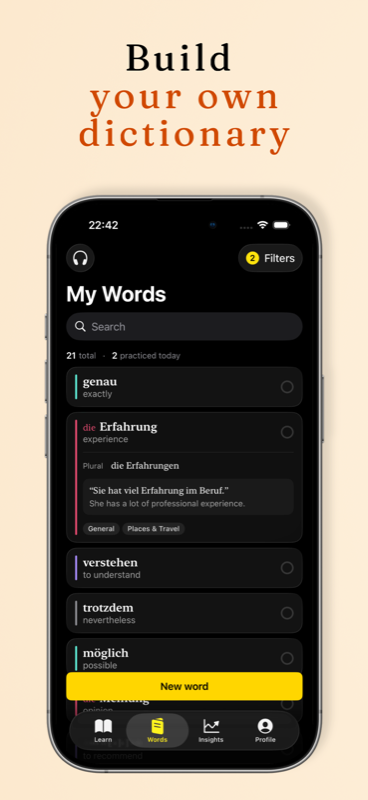
- Every noun card carries article + plural + examples, and there's a dedicated der/die/das drill — the thing generic apps skip.
- Listen Mode plays your words and sentences hands-free for pronunciation and listening practice.
- AI Autofill: add any word you meet in real life and the app completes gender, plural, translations and example sentences in seconds — the Anki workflow without the Anki housework.
- Streaks, daily goals and Focus Mode (it can block your social apps until today's practice is done) protect the habit that makes everything else work.
Judge it against the checklist yourself
The app is free to download and practice with — Premium AI features come with a 7-day free trial. If it doesn't beat your current setup on the four points above, delete it. It's rated 4.8 on the App Store.
 Download free on the App Store
Bottom line
If you want a full guided course, Babbel or Duolingo are fine companions. If you want maximum control and don't mind building it, Anki works. But if the goal is specifically a German vocabulary that grows every day with articles, plurals and pronunciation attached — use a dedicated German vocabulary trainer, and hold it to the four-point checklist.