 Pretzly
Learn German in 10 Minutes a Day — and Actually Stay Consistent
Most people don't fail German because it's hard. They fail because week three arrives, life gets loud, and the streak dies. This is a guide to the consistency problem.
Why 10 minutes daily beats 2 hours on Sunday
Memory consolidates between study sessions, not during them. Seven 10-minute sessions give your brain seven consolidation cycles — sleep included — while one 70-minute session gives it one. For vocabulary specifically, spacing is the whole ballgame: a word seen today, tomorrow, and Thursday is a word you keep. A word seen twelve times on Sunday is a word you recognize until Wednesday.
Ten minutes is also small enough to survive your worst days — and a habit's survival on bad days is what decides whether it exists at all.
What fits in 10 minutes
More than you'd think, if the session is pre-built for you:
- Minutes 1–6: a mixed exercise session — 10–15 words, new and due-for-review, translation and der/die/das drills.
- Minutes 7–9: add 1–2 words you met today and let AI fill in the card.
- Minute 10: hit play on Listen Mode and let the day's words read themselves to you.
That's 300–450 words a month touched, with reviews scheduled so the right ones come back. Compounded over a year, that's a B1-sized vocabulary — from ten minutes a day. (The math: how many words you need to be fluent.)
The habit mechanics that actually hold
- Anchor it to an existing routine. "After my morning coffee" beats "sometime today". The trigger does the remembering, not you.
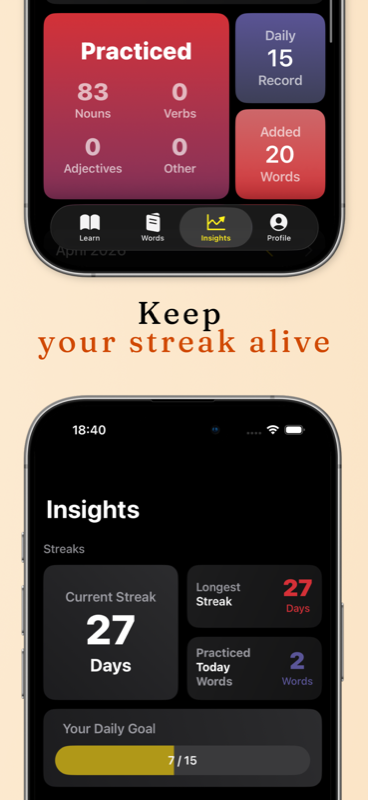
- Make the goal visible. A daily word goal with a progress bar (7/15…) turns an abstract ambition into a checkbox your brain wants closed.
- Protect the streak. Streaks get mocked, but the mechanism is real: after day 20, not practicing costs something you own. That asymmetry carries you through unmotivated evenings.
- Put the habit in front of the distraction. This is the strongest lever most apps don't have — see below.
Turn scroll time into study time
Be honest about where the 10 minutes will come from: the same place the doomscrolling lives. Instead of fighting your phone, chain the two together. Focus Mode in Pretzly lets you pick the apps that eat your evenings — Instagram, TikTok, whatever yours are — and blocks them until today's practice is done. Open Instagram → it's locked → the fastest way in is 10 minutes of German. Every distraction becomes a trigger to learn.
It reframes the habit completely: you don't need discipline to start the session; you need the session to get to your apps. The default flips from "skip" to "do".
Built for the consistency problem
Daily goals, streaks, Insights that show your practice by month, gentle reminders — and Focus Mode to make your own phone work for you instead of against you. The learning method is spaced active recall; the habit machinery makes sure it actually happens.
 Start your streak — free
What if I miss a day?
Miss one day: shrug, continue — one gap doesn't erase consolidated words. Miss two: your only job is a 2-minute session today; the goal is keeping the identity ("I practice German daily") alive, not the numbers. Never let a broken streak become the excuse to quit — restart small, immediately.