 Pretzly
How Many German Words Do You Need to Be Fluent?
Short answer: about 4,000–5,000 words for comfortable conversation — but the first 2,000 do most of the work. Here's the full breakdown by level.
Vocabulary size by CEFR level
| Level | Active vocabulary | What you can do | Typical time |
|---|---|---|---|
| A1 | ~500 | Introduce yourself, order food, survive everyday situations | 1–2 months |
| A2 | ~1,300 | Routine conversations about family, work, shopping | 3–4 months |
| B1 | ~2,400 | Handle most travel situations, express opinions, tell stories | 6–9 months |
| B2 | ~4,000–5,000 | Fluent conversation with native speakers, work in German | 12–18 months |
| C1 | ~8,000 | Nuanced, spontaneous language for academic and professional life | 2+ years |
| C2 | 16,000+ | Near-native precision | — |
Educated native speakers know 50,000+ words — but they use a small fraction of them. Fluency is not a native-sized dictionary; it's fast, automatic access to the words conversations actually need.
The frequency shortcut
German word frequency follows a steep curve: the 1,000 most common words cover roughly 85% of everyday speech, and the top 3,000 push past 95%. That means the order you learn words in matters enormously. A learner who knows the top 2,800 words by frequency will out-communicate one who knows 5,000 scattered words from textbook chapters about castles and classroom objects.
This is why a curated, frequency-based word list beats "learn everything you see". Every word you study should earn its place.
Active vs. passive vocabulary
Recognizing "die Erfahrung" when you read it is passive knowledge. Producing it mid-sentence, with the right article, is active knowledge — and it's what fluency is made of. The gap between the two is closed by retrieval practice: being tested, not re-reading. If your study routine never forces you to produce the word from memory, your passive vocabulary grows while your speaking stays stuck.
2,800 words, chosen for you, tracked for you
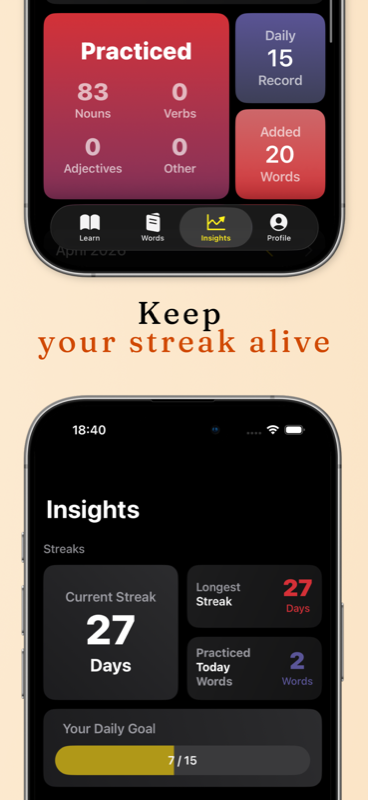
Pretzly ships the 2,800 highest-value German words from A1 to C2, each with article, plural, audio and example sentences. Exercises force active recall, and Insights shows your word count growing by part of speech — so "how many words do I know?" always has a real answer.
 Count your words — free
How fast can you realistically get there?
At a sustainable 10–15 new words a day with spaced review:
- 500 words (A1): ~6 weeks
- 2,400 words (B1): ~8–10 months
- 4,500 words (B2): ~15–18 months
The constraint is never ambition — it's consistency. Ten minutes daily for a year beats every intensive plan that gets abandoned in March. If consistency is your weak point, read our guide to learning German in 10 minutes a day.