 Pretzly
How to Learn German Vocabulary Fast: 7 Techniques That Work
Most vocabulary advice is folklore. These seven techniques have actual evidence behind them — and two popular ones don't.
1. Test yourself instead of re-reading
The single best-documented finding in memory research: retrieval practice beats review. Reading a word list ten times feels productive; being forced to produce "genau" when you see "exactly" is what builds the memory. Every study session should be a quiz, not a read-through.
2. Space your reviews
You forget on a curve — steep at first, flattening with each successful recall. Reviewing a word right before you'd forget it resets the curve with interest. In practice: meet a new word today, see it again tomorrow, then in three days, then a week. Apps handle this scheduling automatically; the point is that one exposure is never enough, and ten exposures in one sitting are wasted.
3. Learn words in sentences, not in isolation
"Erfahrung = experience" is a fact. "Sie hat viel Erfahrung im Beruf" is a memory with hooks: grammar, rhythm, a situation. Context sentences roughly double what you retain per word, and they quietly teach word order and prepositions for free.
4. Attach the article and plural from day one
For German specifically: a noun learned without die … / die Erfahrungen is a word you'll have to learn twice. Gender drives adjective endings, cases and pronouns — bolt it on from the first exposure. (Struggling with genders? See how to remember der, die, das.)
5. Hear and say every word
Adding sound creates a second memory trace and saves you from fossilized mispronunciations. Hear the native audio, repeat out loud — even whispered on the train. Listening-based review also turns dead time (commute, dishes) into study time.
6. Prioritize by frequency
The 1,000 most common German words cover ~85% of daily speech. Learning "der Bahnhof" before "die Schneeflocke" isn't cheating — it's the whole game. Use a frequency-curated list for your level instead of hoovering up every word you meet. (More on numbers: how many words you need to be fluent.)
7. Small daily batches, protected by a habit
10–15 new words a day, every day, outruns any weekend marathon — memory consolidates between sessions, not during them. The bottleneck is showing up daily, which is a habit-design problem, not a discipline problem: streaks, a visible daily goal, and removing friction do more than willpower.
What to skip
- Passive immersion alone. Netflix with subtitles is pleasant reinforcement, but without retrieval practice the words don't become yours.
- Copying word lists by hand. Writing feels virtuous but is mostly transcription, not recall. Test yourself instead.
All seven techniques, in one app
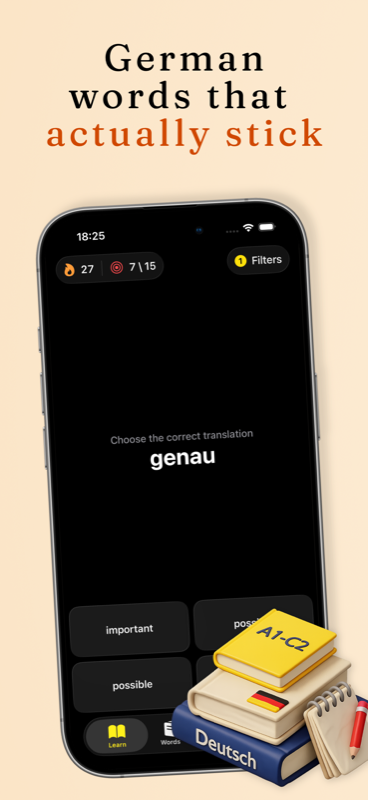
Pretzly is built around exactly this playbook: frequency-curated words by level (A1–C2), quiz-style active recall, example sentences on every card, articles and plurals attached, audio via Listen Mode, and streaks + daily goals to protect the habit. Add your own words and AI Autofill builds the full card in seconds.
 Learn faster — free on iOS
A sample 10-minute daily session
- Minutes 1–6: exercise session — mixed translation and article quizzes, new words and due reviews.
- Minutes 7–9: add 1–2 words you met today (a sign, a conversation, a song) and let Autofill complete them.
- Minute 10: play Listen Mode for the day's words while you close your rings, make coffee, whatever.
That's the whole method. Do it daily and the compounding takes care of the rest.