 Pretzly
How to Remember Der, Die, Das: Rules & Tricks That Work
German noun gender feels random — but most of it isn't. Here's the system that lets you predict the article the majority of the time, and how to drill the rest into instinct.
Why German articles feel impossible (and why they aren't)
English has one word for "the". German has three — der (masculine), die (feminine) and das (neuter) — and the gender of a noun often has nothing to do with its meaning. A girl (das Mädchen) is neuter; a table (der Tisch) is masculine. Trying to reason your way to the article is a dead end.
The good news: noun endings predict gender far more reliably than meaning does. Learn a dozen ending patterns and you can call the article correctly for most nouns you meet — then daily practice handles the exceptions.
The ending patterns that decide the article
Always die (feminine)
- -ung — die Zeitung, die Erfahrung, die Wohnung
- -heit / -keit — die Freiheit, die Möglichkeit
- -schaft — die Freundschaft, die Wissenschaft
- -ion / -tät — die Nation, die Universität
- Most nouns ending in -e — die Lampe, die Sprache (watch out: der Junge, der Name)
Always das (neuter)
- -chen / -lein (diminutives) — das Mädchen, das Büchlein
- -um / -ment — das Zentrum, das Dokument
- Most nouns starting with Ge- — das Gespräch, das Gebäude (exception: die Geschichte)
- Infinitives used as nouns — das Essen, das Lernen
Usually der (masculine)
- -ling / -ist / -or / -ismus — der Frühling, der Tourist, der Motor, der Optimismus
- Male people and animals — der Vater, der König
- Days, months, seasons, weather — der Montag, der Winter, der Regen
Memory tricks that actually help
- Never learn a bare noun. The single biggest mistake is memorizing "Tisch = table". Always learn der Tisch as one unbreakable unit. If the article isn't attached from day one, you'll be guessing forever.
- Color-code the genders. Blue for der, red for die, green for das. Visual association gives your memory a second retrieval path.
- Exaggerate with imagery. For stubborn nouns, build an absurd mental image that encodes the gender — a moon (der Mond) flexing its biceps sticks better than a rule.
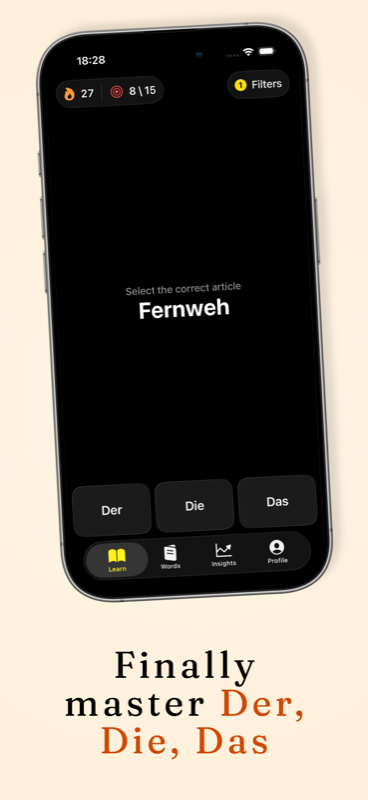
- Drill articles as their own exercise. Reading rules is passive. Being shown "Fernweh" and having to choose der/die/das under light time pressure — active recall — is what actually builds the reflex.
Practice der, die, das until it's instinct
Pretzly has a dedicated article-training exercise: the app shows you a noun, you pick der, die or das, and every word you ever save carries its article, plural and example sentences. A few minutes a day and gender stops being a guessing game.
 Download free on the App Store
What about the exceptions?
Ending patterns cover the majority of nouns, but German keeps a healthy stock of exceptions (die Geschichte despite Ge-, der Name despite -e). Don't fight them with more rules — catch them through repetition. When you meet an exception, save it, tag it, and let spaced practice bring it back until it sits. That's a five-second workflow in the app: add the word, AI Autofill fills the article, plural and examples, done.
The 30-day article plan
- Week 1: learn the die-endings (-ung, -heit, -keit, -schaft, -ion). Practice 10–15 words a day.
- Week 2: add the das-patterns (-chen, -lein, Ge-, -um). Keep reviewing week 1 words.
- Week 3: add the der-patterns (-ling, -or, -ismus, days/months/weather).
- Week 4: switch to mixed article drills and let the app surface the ones you keep missing.
By the end of the month you won't be reciting rules — you'll just hear that "die Wohnung" is right and "das Wohnung" is wrong. That's the goal.