 Pretzly
German Perfekt Explained: Haben or Sein + Participle
The Perfekt is the past tense Germans actually use when they talk. Master one auxiliary rule and one participle system, and you can tell stories about yesterday.
What the Perfekt is (and why it matters more than Präteritum)
German has two past tenses, but they're not interchangeable in real life. The Präteritum (ich ging, ich kaufte) lives mostly in writing — novels, news. The Perfekt (ich bin gegangen, ich habe gekauft) is what Germans say out loud, almost exclusively. If your goal is conversation, the Perfekt is the past tense to learn — plus the Präteritum of just sein, haben and the modals (ich war, ich hatte, ich konnte), which stay common even in speech.
The recipe is always the same: haben or sein (conjugated) + past participle at the end of the sentence.
Ich habe gestern ein Buch gekauft. — I bought a book yesterday.
Sie ist nach Berlin gefahren. — She went to Berlin.
Haben or sein? One rule covers 90%
Use sein when the verb describes movement from A to B (gehen, fahren, fliegen, kommen) or a change of state (aufwachen, einschlafen, sterben, werden) — plus the two odd ones out, sein and bleiben. Everything else takes haben — including all reflexive verbs and any verb with a direct object.
| sein | haben |
|---|---|
| Ich bin gekommen / gefahren / aufgewacht / geblieben | Ich habe gegessen / gearbeitet / gesehen / mich gefreut |
| Motion A→B, change of state, sein & bleiben | Everything else (incl. all verbs with objects) |
Building the participle: three patterns
- Regular (weak) verbs: ge- + stem + -t. machen → gemacht, kaufen → gekauft, arbeiten → gearbeitet.
- Irregular (strong) verbs: ge- + (changed) stem + -en. sehen → gesehen, trinken → getrunken, gehen → gegangen. The vowel change can't be predicted — these are learned per verb.
- No ge- at all: verbs ending in -ieren (studieren → studiert) and verbs with inseparable prefixes be-, ver-, er-, ent-, emp-, ge-, zer- (verstehen → verstanden, bekommen → bekommen). Separable-prefix verbs squeeze ge- into the middle: aufstehen → aufgestanden.
The irregular participles worth learning first
Frequency does the prioritizing for you — these cover an enormous share of everyday speech:
| Verb | Perfekt | Meaning |
|---|---|---|
| gehen | ist gegangen | to go |
| fahren | ist gefahren | to drive/travel |
| essen | hat gegessen | to eat |
| trinken | hat getrunken | to drink |
| sehen | hat gesehen | to see |
| sprechen | hat gesprochen | to speak |
| nehmen | hat genommen | to take |
| finden | hat gefunden | to find |
| schreiben | hat geschrieben | to write |
| bleiben | ist geblieben | to stay |
How to actually learn this
Don't memorize conjugation tables in isolation. Learn each verb as a package — infinitive + auxiliary + participle, inside a sentence: "fahren — Sie ist nach Berlin gefahren." The sentence encodes the sein-rule, the participle and the word order (participle at the end) in one memory. Then let spaced practice bring the verb back until producing "ist gefahren" is automatic.
Verb tenses on every card
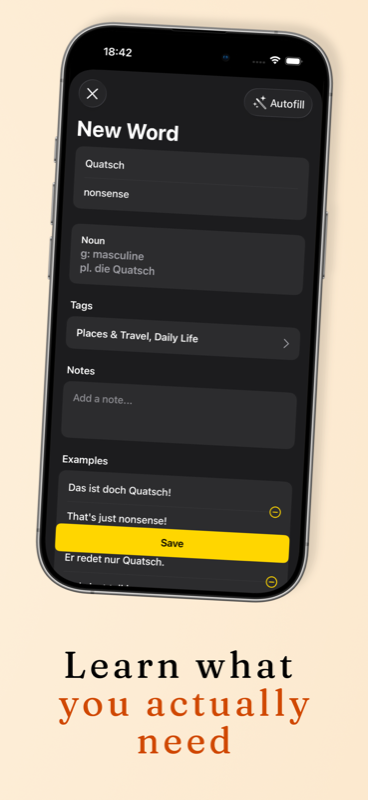
In Pretzly, every verb card carries its tense forms and real example sentences — add any verb you meet and AI Autofill completes the grammar for you, including the participle and example usage. Practice daily and the haben/sein choice becomes instinct, not arithmetic.
 Learn verbs with context — free
Common mistakes to avoid
- Participle not at the end: ~~Ich habe gekauft ein Buch~~ → Ich habe ein Buch gekauft.
- Sein with transitive fahren: if there's an object, it's haben — Ich habe das Auto in die Garage gefahren.
- Adding ge- to -ieren verbs: ~~gestudiert~~ → studiert.
- Translating "I was" with Perfekt: for sein/haben themselves, Germans prefer Präteritum — Ich war müde, not ~~Ich bin müde gewesen~~ (grammatical, but bookish).