 Pretzly
German Comparative & Superlative Forms, Explained
Good news: German comparison is more regular than English — no "more interesting" vs "prettier" dilemma. One suffix, one pattern, a short list of irregulars.
The basic pattern: -er and am -sten
Every German adjective compares the same way, no matter how long it is:
| Positive | Comparative | Superlative |
|---|---|---|
| schnell (fast) | schneller | am schnellsten |
| schön (beautiful) | schöner | am schönsten |
| interessant | interessanter | am interessantesten |
Note the trap for English speakers: German never uses "mehr" for comparison. It's interessanter, not ~~mehr interessant~~ — even for long adjectives. Adjectives ending in -d, -t, -s, -ß, -z insert an -e- in the superlative for pronunciation: am interessantesten, am lautesten.
When the umlaut appears
Most one-syllable adjectives with a, o or u take an umlaut in both forms:
- alt → älter → am ältesten
- groß → größer → am größten
- jung → jünger → am jüngsten
- kalt → kälter → am kältesten; klug → klüger; kurz → kürzer; warm → wärmer; stark → stärker
But not all: laut → lauter, klar → klarer, froh → froher. Like noun plurals, the umlaut is a per-word fact — learn the comparative with the adjective, and the guesswork disappears.
The irregulars (there are only a handful)
| Positive | Comparative | Superlative | Meaning |
|---|---|---|---|
| gut | besser | am besten | good |
| viel | mehr | am meisten | much/many |
| gern | lieber | am liebsten | gladly (to like doing) |
| hoch | höher | am höchsten | high |
| nah | näher | am nächsten | near |
gern/lieber/am liebsten is the one English has no equivalent for — it's how Germans rank preferences: Ich trinke gern Kaffee, lieber Tee, am liebsten Wasser. Extremely high-frequency; learn it as a set.
Als vs. wie — the comparison words
- Unequal → als: Berlin ist größer als München.
- Equal → (genau)so … wie: Er ist so alt wie ich.
Mixing these up (~~größer wie~~) is a classic learner mistake — and a common colloquialism in some German regions, which is exactly why textbooks drill it. Standard German: comparative + als, equality + wie.
Before a noun: don't forget the ending
Comparatives and superlatives used before a noun take normal adjective endings on top: der schnellere Zug, mein älterer Bruder, der schönste Tag. The am -sten form is only for after verbs (Dieser Zug ist am schnellsten); before a noun use der/die/das -ste.
Comparison forms on every adjective card
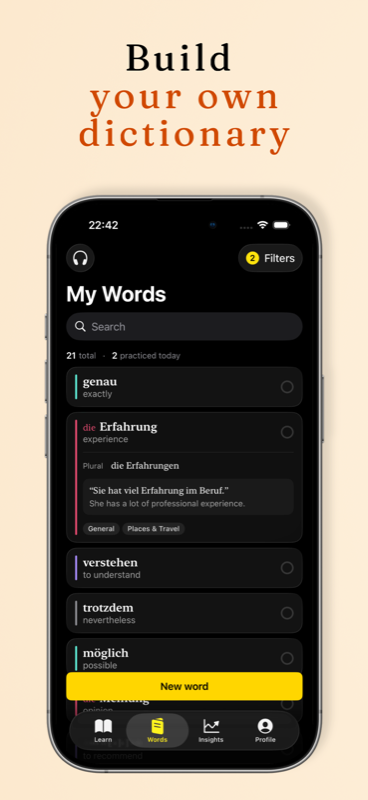
Pretzly shows the comparative and superlative on every adjective, alongside example sentences — add any adjective and AI Autofill fills the forms, including the umlauts and irregulars. Practice them like vocabulary, because in German, they are vocabulary.
 Get Pretzly — free
Quick self-test
Cover the answers: kalt → ? (kälter, am kältesten). gern → ? (lieber, am liebsten). teuer → ? (teurer, am teuersten — note the dropped e). hoch → ? (höher, am höchsten). "He's taller than me" → Er ist größer als ich.