 Pretzly
How to Improve Your German Pronunciation (Without a Tutor)
German pronunciation is more regular than English — once your mouth learns five unfamiliar sounds and your ear learns to hear them.
The good news about German pronunciation
Unlike English, German is largely spelled the way it sounds. Once you know the letter-to-sound rules, you can pronounce words you've never heard. There are no "though/tough/through" traps. The work is concentrated in a handful of sounds English doesn't have — master those and you'll sound dramatically better.
The five sounds English speakers get wrong
- ü — say "ee", keep your tongue there, round your lips like "oo". über, müde, fünf. Not "ooh": füllen (to fill) and fühlen (to feel) differ only here.
- ö — say "ay" and round your lips. schön, hören, möglich.
- ch (soft, after i/e) — a hissed "h" like the start of "huge": ich, möglich, sprechen. Not "sh", not "k".
- ch (hard, after a/o/u) — the throat-clearing sound in "Bach": Buch, Nacht, auch.
- r — a soft gargle at the back of the throat at the start of syllables (rot, Reise); nearly a vowel at the end (Feierabend ends "-abent", the r almost disappears in "-er" endings: Lehrer → "Lehra").
Two bonus rules that instantly reduce your accent: final -d, -b, -g harden to t, p, k (Feierabend → "…abent"), and w sounds like English v (Wasser → "Vasser") while German v usually sounds like f (Vater → "Fater").
The routine: listen, repeat, compare
You can't produce a sound you can't hear. The core loop, five minutes a day:
- Listen to a native-quality recording of a word and a full sentence — rhythm and stress live in sentences, not isolated words.
- Repeat out loud immediately, imitating pitch and stress, not just the sounds. German stresses the first syllable of most native words: FEIerabend, ARbeiten.
- Compare and repeat. Play it again. Was your ü rounded? Did your final -d harden? Once per word is enough — consistency across days does the rest.
Do this with the vocabulary you're already learning and pronunciation stops being a separate chore — every new word arrives with its sound attached.
Listen Mode: pronunciation practice on autopilot
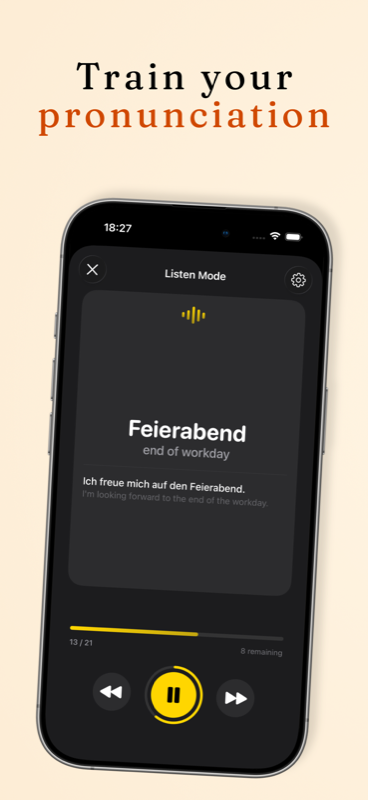
Pretzly plays your words and their example sentences aloud with natural AI voices — hands-free, like a podcast built from your own dictionary. Commute, gym, dishes: press play, repeat after it, and your ear tunes itself to German daily.
 Try Listen Mode — free trial
Common questions
Should I worry about sounding perfect?
No. Aim for clear, not native. Germans are used to accents; what causes misunderstandings is vowel length (Stadt vs Staat) and the ü/u distinction — exactly the things the daily loop fixes.
Is it too late to fix my pronunciation?
Fossilized habits come from repeating words you've only ever read. The fix is the same as prevention: stop learning words silently. Attach audio to every new word from now on, and re-listen to your old core vocabulary once.