 Pretzly
Learn German by Listening: Turn Dead Time into Study Time
Your commute, your gym session, your dishes — that's 5–10 hours a week your ears aren't doing anything. Here's how to make listening actually teach you German, not just wash over you.
Can you really learn German just by listening?
Partly — and the part matters. Listening is how you build comprehension, rhythm and pronunciation: your brain learns where words begin and end, how sentences rise and fall, what ü and ch actually sound like. Native-level listening input is also the strongest defense against the classic learner problem of understanding textbook German but panicking at real speech.
What listening alone won't do is build active vocabulary — you can't produce a word you've only ever heard in passing. The fix isn't to abandon listening; it's to connect it to the words you're actively studying. Listening to vocabulary you've just practiced is a different activity from having German radio on in the background — one consolidates, the other decorates.
Active vs. passive listening
- Passive listening (background podcasts, music) tunes your ear to German sounds and prosody. Pleasant, low effort, low yield per hour. Fine as a supplement.
- Active listening means you know what you're hearing and respond to it: repeating aloud, anticipating the translation, replaying what you missed. This is where hours convert into skill.
The three techniques that convert listening into learning
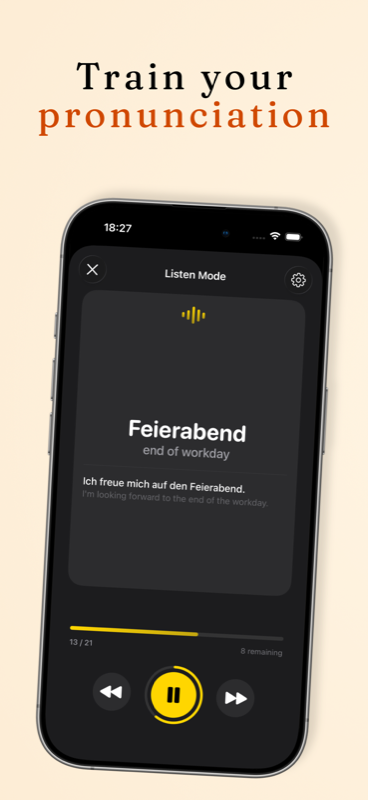
- Listen to your own vocabulary. The highest-yield audio isn't a stranger's podcast — it's the words and example sentences you're currently learning, played back with native-quality audio. Hearing "Feierabend — Ich freue mich auf den Feierabend" the same week you practiced it welds sound to meaning.
- Shadow. Repeat what you hear a half-second behind the speaker, imitating melody and stress, not just sounds. Two minutes of shadowing does more for your accent than twenty minutes of silent listening. (Details in our pronunciation guide.)
- Anticipate. When you hear a German word you know, race the audio to its meaning; when you hear the translation, try to produce the German before the speaker does. This turns passive playback into retrieval practice — the mechanism that actually builds fluency.
What to listen to at each level
| Level | Listen to | Why |
|---|---|---|
| A1–A2 | Your vocabulary with example sentences; slow learner podcasts | Comprehensible input — you learn nothing from audio you understand 10% of |
| B1 | Learner podcasts at natural speed; simple native YouTube with subtitles | Bridge from studied German to real German |
| B2+ | Native podcasts, radio, series | Volume and variety; your vocabulary review continues alongside |
Listen Mode: your dictionary as a podcast
Pretzly's Listen Mode plays your words and their example sentences aloud with natural AI voices — hands-free, with player controls, like a podcast generated from exactly what you're learning. Filter by topic or tag, press play on your commute, shadow what you hear. Dead time becomes your daily review.
 Try Listen Mode — free trial
A realistic listening routine
- Morning commute (10 min): Listen Mode on yesterday's and today's words. Shadow out loud if you're alone, subvocalize if you're not.
- Lunch walk (10 min): a learner podcast at your level — pick comprehension over coolness.
- Evening (2 min): your daily exercise session in the app; the words you miss are tomorrow's playlist.
Twenty-two minutes, none of it carved out of your day. That's the whole trick: listening doesn't compete with your schedule, it rides on top of it.