 Pretzly
German Cases Explained Simply
Cases are just German's way of marking who does what to whom — the job English does with word order. Four cases, one table, and a handful of triggers cover almost everything you'll say.
What cases actually do
In English, "the dog bites the man" and "the man bites the dog" mean different things because of word order. German marks these roles on the article instead: Der Hund beißt den Mann — and because den marks the victim, German could even say Den Mann beißt der Hund and mean the same thing. That's the whole trick: cases free up word order by tagging each noun's job.
- Nominativ — the subject, the one doing: der Hund beißt.
- Akkusativ — the direct object, the one it happens to: Ich sehe den Hund.
- Dativ — the receiver/beneficiary: Ich gebe dem Hund das Futter.
- Genitiv — possession: das Futter des Hundes. In speech, Germans mostly replace it with von + Dativ — learn it last.
The one table you need
| Case | masc. | fem. | neut. | plural |
|---|---|---|---|---|
| Nominativ | der | die | das | die |
| Akkusativ | den | die | das | die |
| Dativ | dem | der | dem | den +n |
| Genitiv | des +s | der | des +s | der |
Look at how little actually changes: only masculine changes in the Akkusativ (der → den). Feminine and neuter are identical in Nominativ and Akkusativ. Most of the "case pain" is really just the Dativ row.
The triggers that decide the case for you
You rarely need to reason about roles — prepositions and verbs pick the case mechanically:
- Always Akkusativ: durch, für, gegen, ohne, um — ein Geschenk für den Lehrer.
- Always Dativ: aus, bei, mit, nach, seit, von, zu — Ich fahre mit dem Bus.
- Dativ verbs worth memorizing early: helfen, danken, gehören, gefallen, antworten — Ich helfe dir.
Learn the two preposition lists as chants (für-durch-gegen-ohne-um; aus-bei-mit-nach-seit-von-zu) and you've automated most case decisions in everyday speech.
Why knowing the gender is half the battle
Here's what textbooks underplay: you can't apply a case you know to a gender you don't. "Mit + Dativ" is useless if you don't know whether Bus is der, die or das. This is why case mastery is mostly a vocabulary problem — every noun learned with its article is a noun you can decline. If your genders are shaky, start with how to remember der, die, das.
Cases start with articles — train them daily
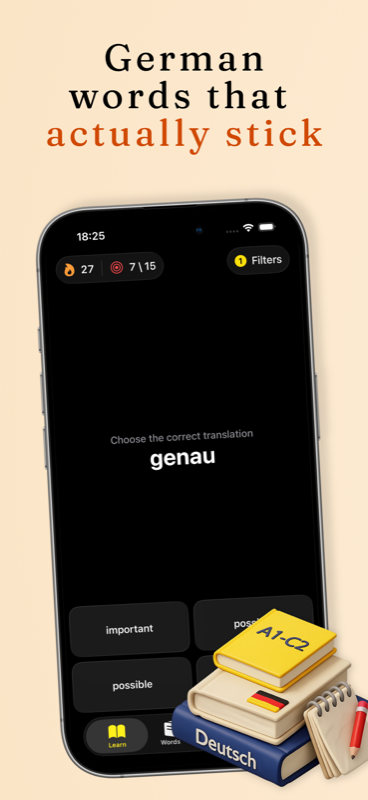
Pretzly drills der/die/das on every noun and shows real example sentences where the cases appear in context. A few minutes a day builds the gender foundation that makes the case table usable in live conversation.


A sane learning order
- Nominativ + Akkusativ only (notice: just der→den). Speak with these for weeks.
- Add the Dativ prepositions chant, then Dativ verbs.
- Two-way prepositions (in, auf, an…) once movement vs location feels relevant.
- Genitiv last — reading knowledge first, production much later.