 Pretzly
German Umlauts: How to Pronounce Ä, Ö and Ü
The two dots aren't decoration — they're the difference between "already" and "beautiful" (schon/schön), between counting and paying (zahlen/zählen). Here's how to make the sounds and how to type them.
Why umlauts can't be skipped
Umlauts are separate vowels, not accented variants. Substituting u for ü doesn't give you an accent — it gives you a different word: schwul (gay) vs schwül (humid) is the classic cautionary pair. They also carry grammar: plurals (Haus → Häuser) and comparatives (alt → älter) often exist only in the dots.
The mouth positions, minus the mysticism
- Ü — say "ee", round your lips. Hold the vowel of "see", then push your lips into a whistle shape without moving your tongue. That's it: müde, fünf, über, Tür.
- Ö — say "ay", round your lips. Start from the vowel of "day" (without the y-glide), round the lips: schön, hören, möchte, Söhne.
- Ä — just an open "e". The easiest of the three: like the e in "bed", often a touch longer: Mädchen, spät, Käse. Long ä and long e sound nearly identical in most of Germany — don't overthink this one.
The tongue-stays/lips-round trick is the whole secret for ü and ö. If your ü sounds like "oo", your tongue slid back — anchor it with "ee" first, every time.
Minimal pairs to train your ear
You can't produce a distinction you can't hear. Drill these pairs — listen, then say both aloud:
| Without umlaut | With umlaut |
|---|---|
| schon (already) | schön (beautiful) |
| zahlen (to pay) | zählen (to count) |
| Mutter (mother) | Mütter (mothers) |
| Ofen (oven) | Öfen (ovens) |
| fordern (to demand) | fördern (to support) |
| Bruder (brother) | Brüder (brothers) |
Notice how many pairs are singular/plural — mishearing an umlaut regularly means misunderstanding how many.
Hear every umlaut in context
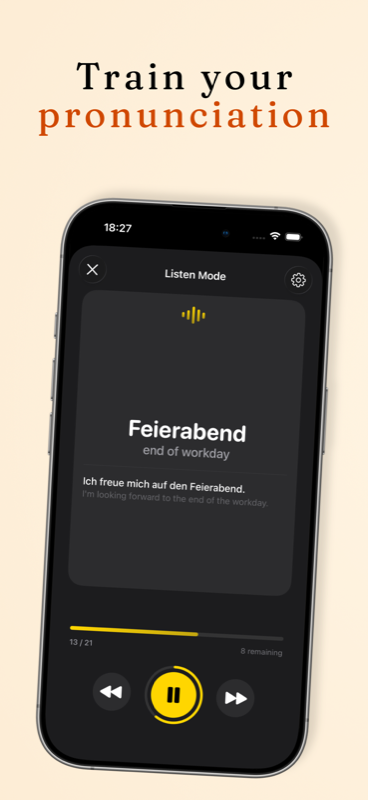
Every word in Pretzly comes with natural audio — words and full example sentences. Play Listen Mode, shadow what you hear, and pairs like Mutter/Mütter stop sounding identical within days. Your ear does the learning; you just press play.


How to type ä, ö, ü (and ß)
- iPhone/iPad: long-press a, o, u or s and slide to the umlaut/ß.
- Mac: long-press the letter (or Option+u, then the vowel).
- Windows: switch to the US-International layout ("+ vowel), or Alt codes: ä 0228, ö 0246, ü 0252, ß 0223.
- No umlauts available? The official fallback is ae, oe, ue, ss — schoen, fuenf, Strasse. Understood everywhere, and how Germans type on foreign keyboards.
A 5-minute daily drill
- Say "ee" → round lips → ü-ü-ü. Say "ay" → round lips → ö-ö-ö. (30 seconds)
- Run five minimal pairs out loud from the table above. (2 minutes)
- Play your current vocabulary with audio and shadow every umlaut word you hear. (2–3 minutes)
Two weeks of this and the sounds stop being foreign objects — they're just vowels you own.