 Pretzly
How Long Does It Take to Learn German?
The honest answer: conversational in about a year of daily practice, comfortable in about two. Here's the level-by-level math — and the levers that actually change it.
The benchmark numbers
The US Foreign Service Institute puts German at roughly 750 class hours to professional working proficiency — more than Spanish or French (~600), far less than Japanese (~2,200). German grammar costs extra up front; the huge shared vocabulary with English pays it back later.
Translated into CEFR levels at a realistic self-study pace (30–60 focused minutes a day):
| Level | You can… | Cumulative time |
|---|---|---|
| A1 | Survive: introduce yourself, order, shop | 1–2 months |
| A2 | Handle routine life: appointments, small talk | 3–5 months |
| B1 | Converse: opinions, stories, most travel situations | 6–9 months |
| B2 | Work and socialize comfortably in German | 12–18 months |
| C1 | Operate professionally/academically with nuance | 2+ years |
What actually changes the timeline
- Consistency beats intensity — by a lot. 30 minutes daily outperforms 4 hours on Sunday, because memory consolidates between sessions. Most "I studied German for two years" stories are really "I studied irregularly for two years."
- Vocabulary is the rate limiter. Grammar is a finite set of rules you can learn in months; the 4,000–5,000 words of B2 are the long pole. At 10–15 new words a day with spaced review, the math works; at "whenever I feel like it," it doesn't. (Full numbers: how many words you need.)
- Active practice multiplies input. An hour of being tested (recall, speaking, writing) is worth several hours of watching or re-reading.
- Living in Germany helps less than expected — unless you force German interactions. Plenty of expats plateau at A2 English-bubble level for years.
A realistic plan that hits the B1-in-9-months line
- Daily, non-negotiable: 10–15 minutes of vocabulary with spaced review — new words plus old ones resurfacing.
- Most days: 15–20 minutes of grammar or listening (alternate: one Perfekt session, one podcast/Listen Mode session).
- Weekly: one real production act — a conversation exchange, a written paragraph, a self-recorded monologue.
That's ~4 hours a week. Sustained for nine months it beats any bootcamp you'll abandon in week three — the entire game is making the daily layer automatic.
Make the daily layer automatic
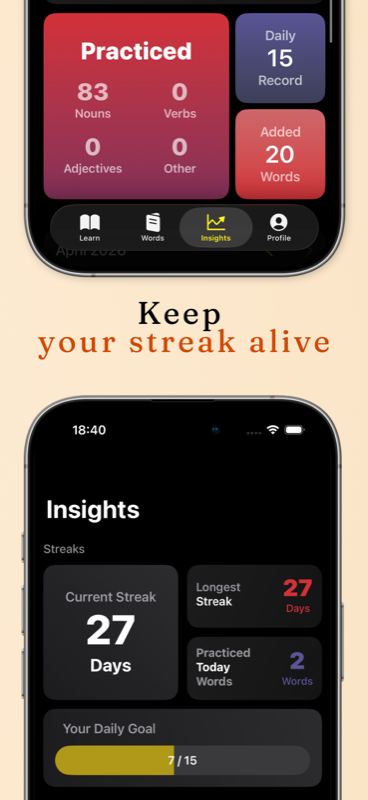
Pretzly handles the non-negotiable layer: a daily goal, spaced exercises over 2800+ words A1–C2, streaks that make missing feel expensive, and Focus Mode that blocks your distracting apps until today's session is done. Progress you can watch in Insights, month by month.


The question behind the question
"How long does it take" usually means "will I still be at this in a year?" Structure answers that better than willpower: a fixed daily trigger, a visible streak, and a session small enough to survive your worst day. Design for consistency and the timeline takes care of itself — read learn German in 10 minutes a day for the full habit design.